



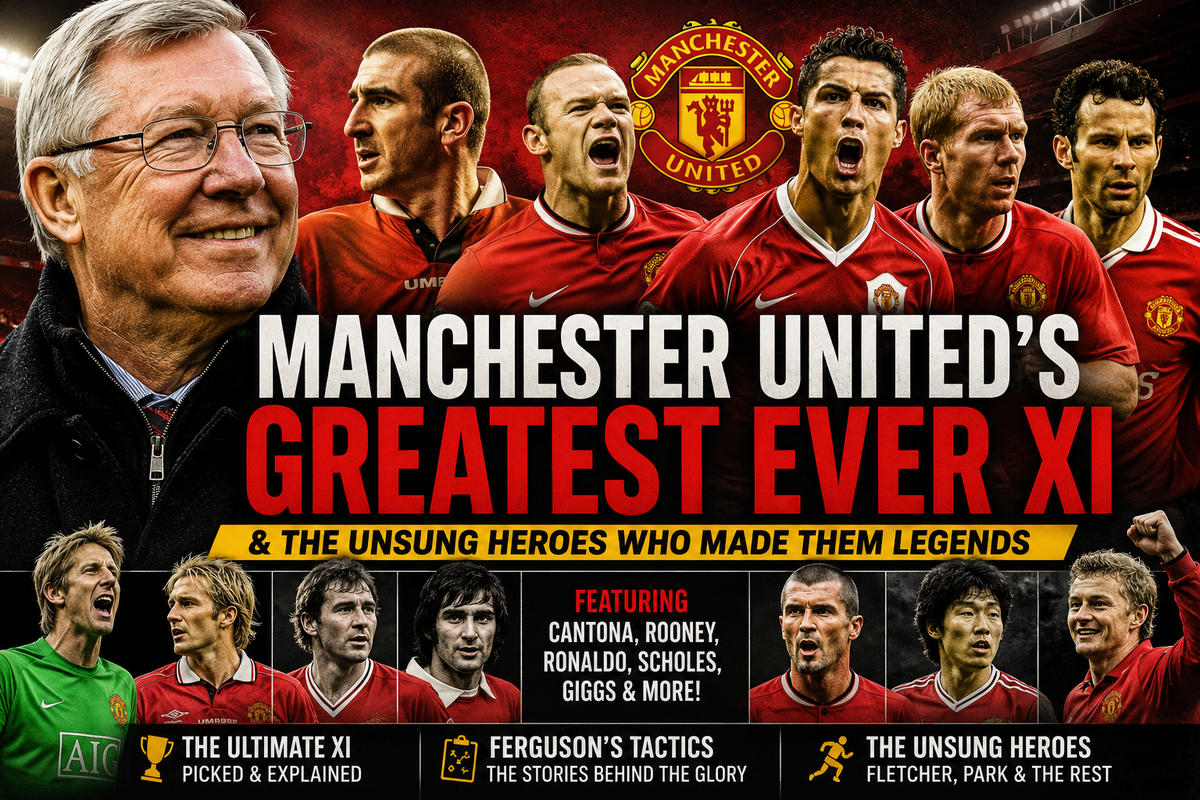
When football fans are asked to name Manchester United's greatest ever XI, the same legendary names inevitably appear. Schmeichel. Cantona. Keane. Giggs. Ronaldo. Rooney.
But building the greatest Manchester United team isn't just about selecting the most talented footballers.
It's about understanding why Sir Alex Ferguson won 38 major trophies over 26 years at Old Trafford. His greatest sides weren't simply collections of superstars—they were perfectly balanced teams built around leaders, technicians, warriors and selfless tactical specialists.
After countless debates, this is my all-time Manchester United XI.
My Greatest Manchester United XI
Formation: 4-4-2
Goalkeeper
-
Peter Schmeichel
Defence
-
Gary Neville
-
Jaap Stam
-
Rio Ferdinand
-
Denis Irwin
Midfield
-
Cristiano Ronaldo
-
Roy Keane (Captain)
-
Paul Scholes
-
Ryan Giggs
Attack
-
Eric Cantona
-
Wayne Rooney
The Bench That Could Win the Premier League
Choosing the substitutes proved almost harder than selecting the starting side.
Bench
-
Edwin van der Sar
-
Nemanja Vidić
-
Steve Bruce
-
Patrice Evra
-
Bryan Robson
-
David Beckham
-
George Best
-
Sir Bobby Charlton
-
Denis Law
-
Ruud van Nistelrooy
-
Ole Gunnar Solskjær
Read that list again.
George Best.
Sir Bobby Charlton.
Denis Law.
David Beckham.
Bryan Robson.
Most football clubs would build an entire museum around just one of those players. Manchester United somehow leaves them on the bench.
That says everything about the club's history.
The Impossible Decisions
Cantona or Charlton?
This was perhaps the toughest selection.
Sir Bobby Charlton remains one of the greatest footballers England has ever produced and was the heartbeat of United's European Cup-winning side in 1968.
But Eric Cantona changed Manchester United forever.
When Cantona arrived in 1992, United hadn't won the league for 26 years.
By the time he retired, they had become the dominant force in English football.
His influence extended far beyond goals or assists. He walked into Old Trafford with an aura that instantly raised the standards of everyone around him. Gary Neville once described Cantona as a player whose presence made you feel you were witnessing something bigger than football itself.
Sometimes leadership can't be measured with statistics.
Stam or Vidić?
This may divide supporters for decades.
Vidić was fearless, uncompromising and one of the greatest centre-backs in Premier League history.
Jaap Stam, however, was arguably the complete defender.
Fast.
Powerful.
Dominant in the air.
Comfortable with the ball.
Almost impossible to beat one-on-one.
Many still believe selling Stam in 2001 was Ferguson's biggest transfer mistake.
Rooney Gets The Nod
Wayne Rooney edges out Ruud van Nistelrooy for one simple reason.
Versatility.
Rooney wasn't simply a striker.
He could play as a number ten, on either wing, as a second striker and even in midfield when required.
He became Manchester United's all-time leading goalscorer while simultaneously creating countless chances for teammates.
Very few players in football history combined elite goalscoring with relentless work rate the way Rooney did.
Ferguson's Secret Weapon: Balance
What separated Ferguson from many great managers wasn't simply his eye for talent.
It was his understanding that football matches aren't won by eleven stars.
They're won by eleven players performing eleven different jobs.
Every great Ferguson side featured leaders.
Every great Ferguson side featured world-class talent.
But every great Ferguson side also featured players willing to sacrifice themselves for the team.
Two names deserve far more recognition than they often receive.
Darren Fletcher: The Ultimate Team Player
Ask many Manchester United supporters about Darren Fletcher and you'll often hear the same word.
Underrated.
Ferguson himself repeatedly defended Fletcher against criticism because he understood his importance.
Fletcher could play centrally, on the right, in holding midfield or as a box-to-box midfielder.
He pressed relentlessly.
Covered teammates.
Won aerial duels.
Protected defenders.
And quietly allowed the stars around him to flourish.
His suspension for the 2009 Champions League Final against Barcelona remains one of the most overlooked moments in modern football.
United missed him enormously.
Ji-Sung Park: Ferguson's Tactical Assassin
No player better demonstrated Ferguson's tactical genius than Ji-Sung Park.
Supporters remember his incredible stamina.
Managers remember something else.
His discipline.
Park accepted jobs most attacking players would hate.
Mark Andrea Pirlo.
Close down Xabi Alonso.
Disrupt Arsenal's passing.
Shut down whichever world-class player Ferguson identified as the biggest threat.
He executed every assignment without complaint.
Years later, Ferguson made one of the most remarkable admissions of his managerial career.
Reflecting on Manchester United's defeat to Barcelona in the 2011 Champions League Final, he said he believed the outcome could have been different had he assigned Park to mark Lionel Messi.
That single statement reveals just how highly Ferguson rated him.
The Day Ferguson Unleashed Four Superstars
If one match perfectly captures Ferguson's philosophy, it wasn't a title decider.
It was Manchester United 5–2 Tottenham Hotspur in April 2009.
United trailed 2–0 at half-time.
Most managers would have looked to tighten midfield.
Protect against a third goal.
Stay patient.
Ferguson saw something entirely different.
He unleashed wave after wave of attacking football.
Cristiano Ronaldo.
Wayne Rooney.
Dimitar Berbatov.
Carlos Tevez.
Four elite forwards attacking together.
United scored five unanswered goals.
Old Trafford became unstoppable.
That wasn't reckless management.
It was Ferguson recognising the psychological moment and trusting extraordinary footballers to overwhelm the opposition.
The Baby-Faced Assassin
Every Manchester United supporter eventually asks the same question.
Where does Ole Gunnar Solskjær fit?
The honest answer is...
Everywhere.
He wasn't merely an outstanding striker.
He may well be the greatest substitute football has ever seen.
His winning goal in the 1999 Champions League Final secured the Treble.
He scored goals for fun.
Never complained.
Never demanded a starting place.
Whenever Ferguson needed a goal, the crowd looked towards one man.
Ole.
Some players become club legends because they dominate every week.
Others become legends because they define the biggest moments.
Ole belongs firmly in the second category.
Why Ferguson Is Still The Greatest
Manchester United produced Ballon d'Or winners.
World Cup winners.
European champions.
Premier League legends.
Yet Ferguson's greatest achievement wasn't signing extraordinary footballers.
It was knowing exactly how to combine them.
He paired Roy Keane's leadership with Paul Scholes' vision.
He blended Cantona's charisma with Giggs' consistency.
He surrounded Ronaldo and Rooney with players like Fletcher and Park who happily sacrificed personal glory for collective success.
That's why Manchester United's greatest ever teams weren't simply talented.
They were complete.
And perhaps that's the hardest part about selecting an all-time Manchester United XI.
No matter who makes the starting eleven, you're always leaving another all-time great on the bench.
Few clubs in world football can say that.
Manchester United can.
Share and get 15% off!
Simply share this product on one of the following social networks and you will unlock 15% off!